
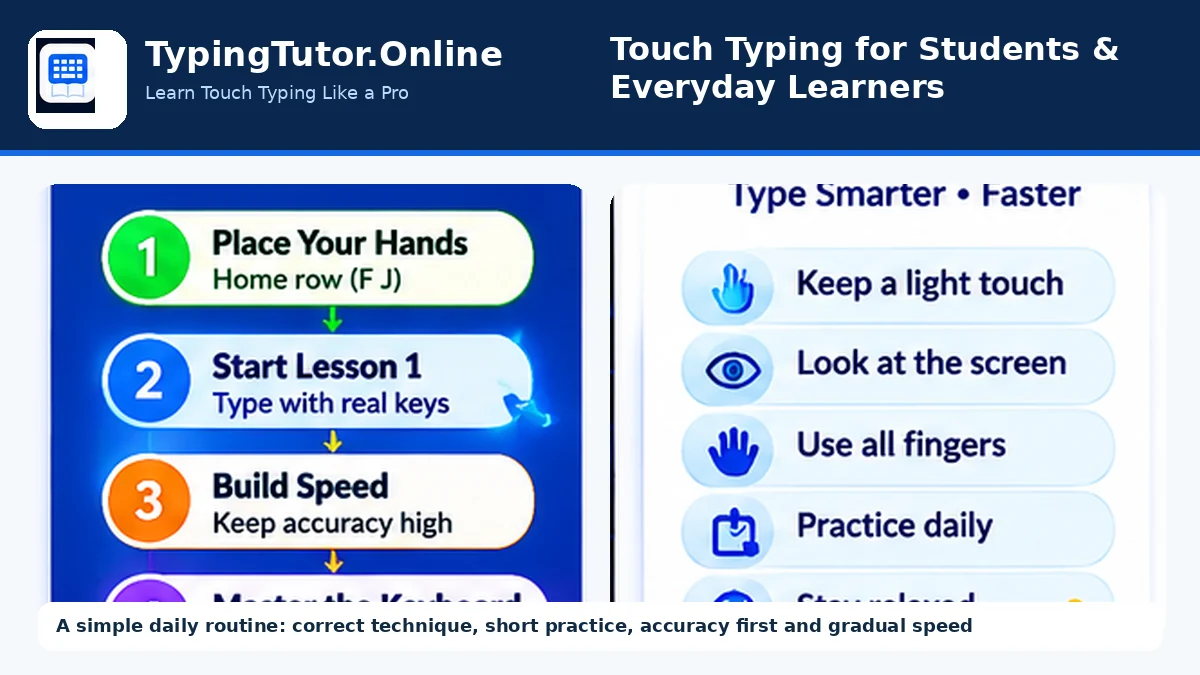
Students often type more than they realize: assignments, research, notes, forms, presentations, messages, exam preparation, and project work. My advice is to learn touch typing early enough that the keyboard becomes a tool rather than a distraction.
Why students should learn technique before chasing speed
When you are still searching for keys, part of your attention is spent on the keyboard instead of the idea you are trying to write. Touch typing reduces that visual search. The purpose is not simply to finish faster; it is to make writing on a computer feel more natural.
Start with the home row
Place your left fingers on A, S, D, F and your right fingers on J, K, L, semicolon. Use the raised F and J keys to relocate your hands by touch. Keep your eyes on the screen and let the fingers learn the distances through repetition.
A study-friendly daily routine
- Practise 10–15 minutes before beginning homework or study.
- Learn only a small number of new keys at a time.
- Repeat difficult lessons instead of skipping them.
- Take a short test once the current keys feel familiar.
- Use games for extra repetition when normal drills feel tiring.
Do not turn every session into a race
Students can become discouraged when they compare their speed with classmates or online scores. I recommend comparing your current result with your own earlier result. A small improvement in accuracy or a reduction in repeated errors is real progress.
Use typing practice to improve real school work
Once you know most of the keyboard, practise complete sentences, punctuation, numbers, and the kinds of words you actually use in class. This helps transfer typing technique from a tutor into assignments and notes.
What to do when a key feels impossible
Slow down and isolate it. Look at which finger should press that key, practise a short combination that includes it, then return to normal text. Weak keys usually improve more quickly with focused repetition than with repeated full-speed tests.
Use progress tools without becoming obsessed with them
Statistics, daily goals, streaks, certificates, and personal bests can be motivating, but they should support learning rather than control it. A student who practises calmly for ten minutes every day is building a stronger habit than one who only practises when trying to earn a badge.
My advice for exams and timed computer work
If you expect to type under time pressure, practise longer passages occasionally. Short drills build individual movements; longer tests show whether you can maintain accuracy and concentration for several minutes.
Make typing a background skill
The best stage is when you stop thinking about the keyboard and start thinking about the content. That is why I encourage students to practise consistently now instead of waiting until typing becomes a problem during university, employment, or professional training.
Students and independent learners can use TypingTutor.Online for guided lessons, tests, games, statistics, certificates, and a dedicated Kids section for younger learners.