
Typing tests and games can both improve practice, but they serve different purposes. My advice is simple: use tests to measure and games to reinforce. Neither should replace the structured lessons that teach correct finger movement.
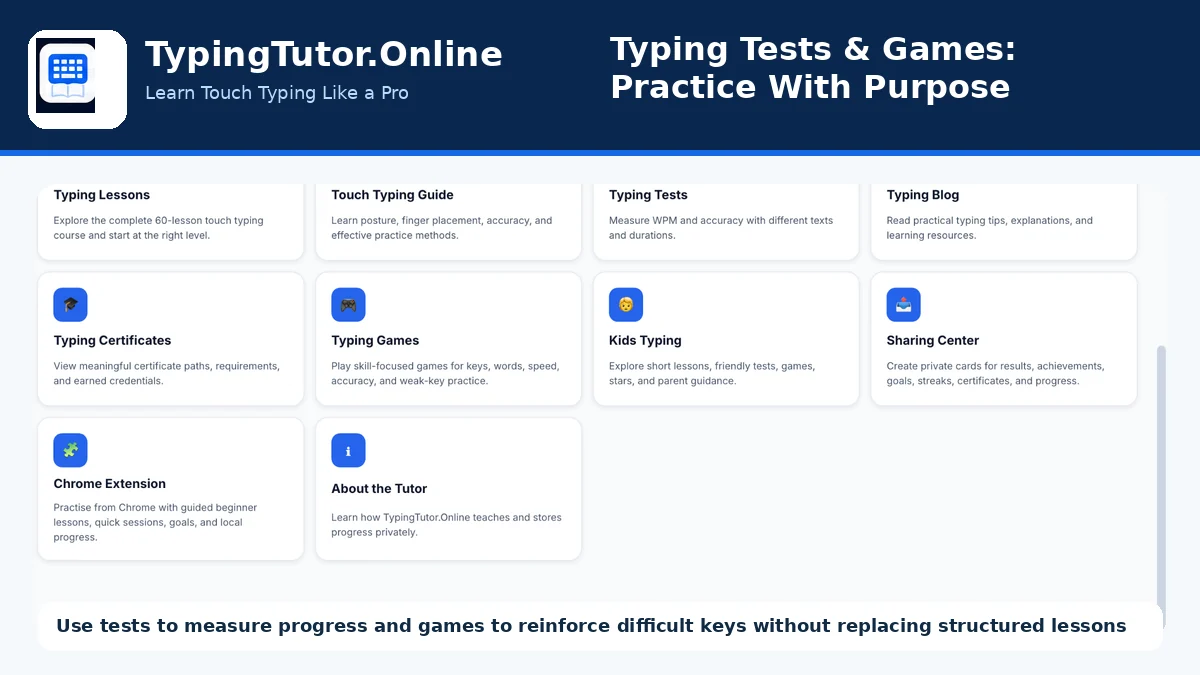
TypingTutor.Online currently provides dedicated Typing Tests and Typing Games sections in addition to its 60-lesson course. That gives learners a useful cycle: learn a skill, practise it, measure it, and then reinforce difficult areas.
What a typing test tells you
A test can show your current typing speed, accuracy, errors, and consistency under a time limit. Those numbers are most useful when you compare them with your own earlier results rather than treating every session like a competition with other people.
If your WPM increases but accuracy falls sharply, the test is telling you that you are pushing speed faster than your technique can support.
How often I recommend taking tests
Beginners do not need to take a test after every lesson. A short test a few times per week is usually enough to see whether structured practice is carrying over into normal text. Experienced typists can test more often when they are working toward a specific speed or accuracy target.
Use more than one test length
A very short test is useful for a quick check, but longer tests reveal whether you can maintain rhythm and accuracy. If you only practise one-minute bursts, you may feel fast without building the endurance needed for reports, data entry, writing, study, or office work.
What typing games are good for
Games can make repetitive practice easier to continue. They are particularly useful when a learner keeps struggling with the same key group, punctuation pattern, numbers, or common word combinations.
Because games provide immediate goals and feedback, they can help children and adults stay engaged. The important point is to keep the same typing technique while playing. Do not abandon correct fingers just to win a round.
A balanced test-and-game routine
- Complete your structured lesson first.
- Review any keys that caused repeated errors.
- Play one short game related to the skill you are learning.
- Take a test after several practice sessions, not necessarily after every one.
- Record or review your WPM and accuracy trend.
- Return to lessons if your accuracy remains low.
Do not chase your personal best every day
A personal-best score is motivating, but trying to beat it in every session can create tension. Some days should be accuracy days. Some should be weak-key days. Some should simply be comfortable practice days.
Use games differently for kids and adults
For children, games can be a reward after focused learning. For adults, games are useful as a break from repetitive drills. In both cases, they work best when connected to a specific skill instead of being random entertainment.
My final advice
Think of the typing course as your teacher, the test as your measuring tool, and the games as extra practice. When those three roles stay clear, the entire learning process becomes easier to manage.
You can explore Typing Tests and Typing Games at TypingTutor.Online after completing your regular lesson practice.